
Fusion 360 defines parametric design, allowing iterative changes with ease. Understand why is fusion 360 parametric design software for engineers.

From years of practical application in product design and mechanical engineering, I’ve seen firsthand how crucial effective CAD software can be. When a client needs rapid iterations or design changes based on evolving requirements, the underlying software architecture truly matters. This is where parametric modeling shines, and it’s why understanding that is fusion 360 parametric design software is fundamental for anyone serious about modern design and manufacturing workflows. Its robust capabilities allow designers and engineers to create flexible, adaptable models, ensuring efficiency from concept to production.
Overview
- Fusion 360 employs a history-based parametric modeling approach.
- Design intent is captured and stored through features and dimensions.
- Changes made to early features automatically update subsequent elements.
- It facilitates rapid iteration and modification of complex designs.
- The software integrates CAD, CAM, and CAE within a unified environment.
- Parameters can be numeric values, equations, or relationships.
- This approach significantly reduces errors and redesign time.
Understanding Why is fusion 360 parametric design software
Working with clients across various industries, from consumer goods to specialized industrial equipment, the question often arises: what makes Fusion 360 so adaptable? The answer lies in its parametric core. Unlike direct modeling, which manipulates geometry directly, parametric modeling uses parameters to define the model’s features. These parameters can be dimensions, relationships between features, or even mathematical equations. When you sketch a rectangle in Fusion 360, you’re not just drawing lines; you’re defining a sketch with explicit dimensions and constraints. These initial definitions form the building blocks.
Every action, from extruding a profile to adding a fillet, becomes a recorded feature in the design timeline. This timeline is the heart of why is fusion 360 parametric design software. It acts as a history log, capturing the sequence and details of every operation. Need to change a hole diameter that was created twenty steps ago? No problem. You simply locate that feature in the timeline, edit the parameter, and Fusion 360 intelligently rebuilds the subsequent geometry. This ripple effect ensures design consistency and dramatically speeds up modification processes. It’s a powerful mechanism for managing complexity in real-world projects.
The History Timeline and Design Intent
At the core of Fusion 360’s parametric functionality is its design timeline. This visual representation allows users to review, edit, or suppress any feature created during the modeling process. Each sketch, extrusion, cut, or pattern operation is logged sequentially. This historical record is not just for auditing; it’s the engine that drives design flexibility. For example, if I’m designing a custom bracket and realize an initial mounting plate needs to be wider, I can go back to the original sketch, adjust its dimension, and the entire bracket automatically scales and updates. This maintains all subsequent features and relationships.
This method emphasizes design intent. Instead of drawing a line of a certain length, I define a dimension. Instead of placing a hole at a specific coordinate, I constrain its position relative to other features. This means the model isn’t just a collection of static shapes. It’s an intelligent assembly of interconnected features. If the base feature changes, the related features follow suit. This approach greatly minimizes errors, especially in complex assemblies where manual recalculation for every change would be tedious and prone to mistakes. It’s a fundamental aspect that sets robust CAD systems apart.
Practical Benefits When is fusion 360 parametric design software
The real-world advantages of Fusion 360’s parametric capabilities are profound. For engineers and product developers, iteration is a constant. Clients frequently request modifications based on testing, material changes, or market feedback. With Fusion 360, these changes are not daunting rebuilds. A quick adjustment of a parameter can ripple through an entire assembly. This efficiency directly impacts project timelines and budgets. For example, a US-based automotive supplier using Fusion 360 can quickly adapt component designs to new vehicle specifications without starting from scratch.
Furthermore, parametric design supports standardization and reusability. Once a part or feature is parametrically defined, it can be easily adapted for multiple similar applications. Imagine a standardized housing with adjustable dimensions for different circuit board sizes. Instead of modeling each variant, you simply adjust the parameters. This consistency reduces manufacturing errors and speeds up production preparation. It also fosters better collaboration among teams, as everyone understands the underlying logic and interdependencies within the model. This makes the question of is fusion 360 parametric design software crucial for team efficiency.
Beyond Basic Modeling: Why is fusion 360 parametric design software
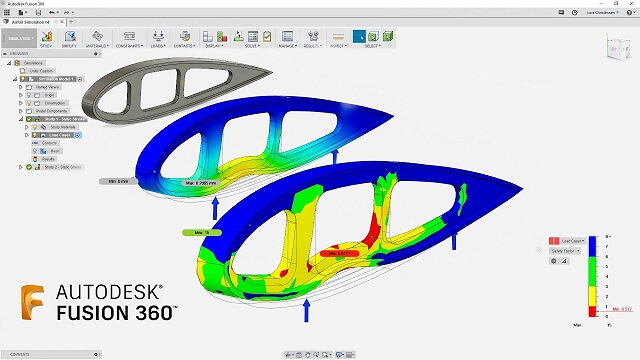
Fusion 360 extends its parametric foundation far beyond simple part creation. Its integrated environment means that changes made in the CAD workspace flow seamlessly into CAM (Computer-Aided Manufacturing) and CAE (Computer-Aided Engineering) modules. If I modify a part’s geometry in the Design workspace, the toolpaths in the Manufacture workspace will automatically update, or at least prompt for an update, ensuring that manufacturing instructions always reflect the latest design. This integration minimizes costly errors that can arise from disconnected workflows.
Moreover, Fusion 360 allows for the creation of design variations using parameters, often through spreadsheets or custom forms. This is particularly useful for product families or custom configurations where a core design needs to be adapted many times. For instance, a furniture maker could parametrically define a chair, then adjust parameters for seat height, back angle, or material thickness to generate multiple designs without manual modeling for each. This capability is another strong indicator that is fusion 360 parametric design software, offering a powerful platform for iterative and intelligent product development. This comprehensive approach empowers users to move from concept to fabrication with fluidity.


